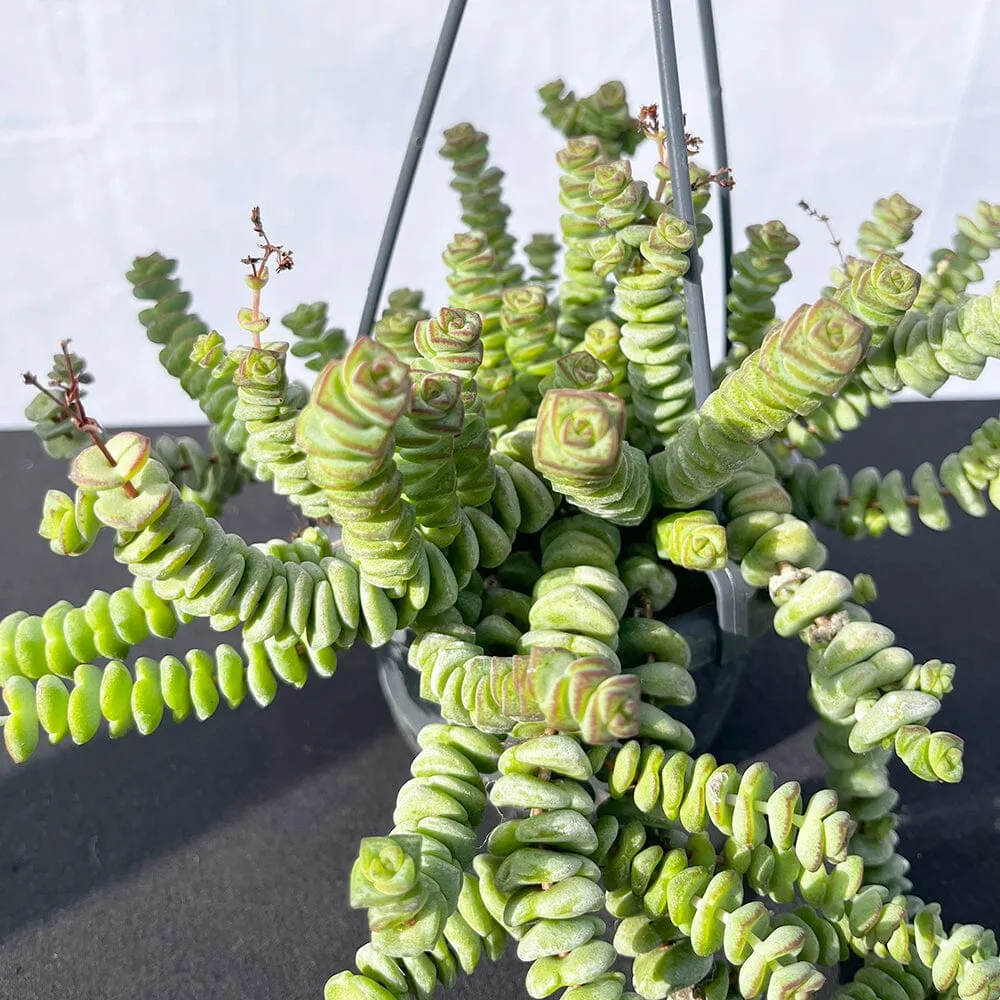
20 - 30cm Crassula Hottentot Succulent in Hanging 14cm Pot
Crassula rupestris ssp. marnieriana ‘Hottentot’, often called the Crassula Hottentot, is a distinctive, compact succulent native to South Africa and Namibia. A member of the Crassulaceae family, this variety is adored for its unique, beaded growth habit and sculptural appearance — a true favourite among collectors and succulent lovers.
The plant forms dense, trailing stems tightly packed with fleshy, round, overlapping leaves, creating a chain-like effect. The leaves are a soft grey-green with red or pink edges that become more vibrant when exposed to bright light. As it matures, ‘Hottentot’ produces small clusters of star-shaped white or pale pink flowers in winter, adding delicate contrast to its geometric foliage.
Compact, elegant, and highly decorative, Crassula ‘Hottentot’ is ideal for hanging planters, terrariums, rock gardens, or sunny windowsills, where its trailing stems can spill beautifully over the edge.
Crassula rupestris ssp. marnieriana ‘Hottentot’ – Care Guide
Light
Thrives in bright light to full sun. Indoors, place near a south- or west-facing window. Gradually acclimatise it to direct sunlight to avoid scorching, as strong sun enhances the red leaf margins and keeps the plant compact.
Watering
Water sparingly. Allow the soil to dry out completely between waterings. Overwatering is the most common cause of problems and can lead to root rot. During the growing season (spring to early autumn), water every 2–3 weeks; in winter, water very rarely.
Temperature and Humidity
-
Temperature: Prefers 18–28°C. Protect from frost and avoid temperatures below 10°C.
-
Humidity: Prefers dry air; thrives in average household humidity.
Soil and Potting
Use a gritty, well-draining cactus or succulent compost. A mix of sand, perlite, and potting soil works well. Ensure pots have drainage holes. Repot every 2–3 years in spring to refresh the soil and encourage new growth.
Feeding
Feed once a month during spring and summer with a diluted cactus fertiliser. Stop feeding in winter when the plant becomes dormant.
Pruning and Maintenance
Trim leggy or damaged stems to maintain a neat, compact shape. Pruned cuttings can be easily propagated by allowing them to callus for a day or two before planting in well-draining soil.
Growth and Maturity
A slow to moderate grower, typically reaching 15–25 cm in height with trailing stems up to 30 cm long. With time, it forms dense, cascading clusters of round leaves.
Common Issues
-
Soft or mushy stems: Overwatering or poor drainage.
-
Wrinkled leaves: Underwatering or prolonged drought.
-
Leggy growth: Too little light.
-
Pests: Occasionally mealybugs or aphids — treat promptly with insecticidal soap or neem oil.
Background and Benefits
Native to the arid regions of South Africa, Crassula ‘Hottentot’ has adapted to store water in its thick leaves, allowing it to thrive in dry, sunny environments. Its compact, architectural shape and trailing habit make it a standout feature in mixed succulent arrangements or minimalist designs. Low-maintenance, drought-tolerant, and long-lived, this variety is ideal for beginners and collectors alike.
✅ Quick Care Summary
-
Light: Bright light to full sun
-
Water: Sparingly; allow soil to dry completely
-
Temperature: 18–28°C; protect below 10°C
-
Humidity: Prefers dry air
-
Soil: Gritty, well-draining cactus compost
-
Feed: Monthly in spring/summer
-
Growth: Compact trailing succulent, 15–25 cm; grey-green leaves with red edges and small pink-white flowers
⚠️ Toxicity Note: Like most Crassula species, ‘Hottentot’ is mildly toxic if ingested. Keep away from pets and children.
🌿 Styling Tip:
Display Crassula ‘Hottentot’ in a hanging pot or geometric planter where its bead-like stems can cascade freely — the perfect way to showcase its sculptural beauty and vibrant colour contrast.
Original: $32.98
-70%$32.98
$9.89Product Information
Product Information
Shipping & Returns
Shipping & Returns
Description
Crassula rupestris ssp. marnieriana ‘Hottentot’, often called the Crassula Hottentot, is a distinctive, compact succulent native to South Africa and Namibia. A member of the Crassulaceae family, this variety is adored for its unique, beaded growth habit and sculptural appearance — a true favourite among collectors and succulent lovers.
The plant forms dense, trailing stems tightly packed with fleshy, round, overlapping leaves, creating a chain-like effect. The leaves are a soft grey-green with red or pink edges that become more vibrant when exposed to bright light. As it matures, ‘Hottentot’ produces small clusters of star-shaped white or pale pink flowers in winter, adding delicate contrast to its geometric foliage.
Compact, elegant, and highly decorative, Crassula ‘Hottentot’ is ideal for hanging planters, terrariums, rock gardens, or sunny windowsills, where its trailing stems can spill beautifully over the edge.
Crassula rupestris ssp. marnieriana ‘Hottentot’ – Care Guide
Light
Thrives in bright light to full sun. Indoors, place near a south- or west-facing window. Gradually acclimatise it to direct sunlight to avoid scorching, as strong sun enhances the red leaf margins and keeps the plant compact.
Watering
Water sparingly. Allow the soil to dry out completely between waterings. Overwatering is the most common cause of problems and can lead to root rot. During the growing season (spring to early autumn), water every 2–3 weeks; in winter, water very rarely.
Temperature and Humidity
-
Temperature: Prefers 18–28°C. Protect from frost and avoid temperatures below 10°C.
-
Humidity: Prefers dry air; thrives in average household humidity.
Soil and Potting
Use a gritty, well-draining cactus or succulent compost. A mix of sand, perlite, and potting soil works well. Ensure pots have drainage holes. Repot every 2–3 years in spring to refresh the soil and encourage new growth.
Feeding
Feed once a month during spring and summer with a diluted cactus fertiliser. Stop feeding in winter when the plant becomes dormant.
Pruning and Maintenance
Trim leggy or damaged stems to maintain a neat, compact shape. Pruned cuttings can be easily propagated by allowing them to callus for a day or two before planting in well-draining soil.
Growth and Maturity
A slow to moderate grower, typically reaching 15–25 cm in height with trailing stems up to 30 cm long. With time, it forms dense, cascading clusters of round leaves.
Common Issues
-
Soft or mushy stems: Overwatering or poor drainage.
-
Wrinkled leaves: Underwatering or prolonged drought.
-
Leggy growth: Too little light.
-
Pests: Occasionally mealybugs or aphids — treat promptly with insecticidal soap or neem oil.
Background and Benefits
Native to the arid regions of South Africa, Crassula ‘Hottentot’ has adapted to store water in its thick leaves, allowing it to thrive in dry, sunny environments. Its compact, architectural shape and trailing habit make it a standout feature in mixed succulent arrangements or minimalist designs. Low-maintenance, drought-tolerant, and long-lived, this variety is ideal for beginners and collectors alike.
✅ Quick Care Summary
-
Light: Bright light to full sun
-
Water: Sparingly; allow soil to dry completely
-
Temperature: 18–28°C; protect below 10°C
-
Humidity: Prefers dry air
-
Soil: Gritty, well-draining cactus compost
-
Feed: Monthly in spring/summer
-
Growth: Compact trailing succulent, 15–25 cm; grey-green leaves with red edges and small pink-white flowers
⚠️ Toxicity Note: Like most Crassula species, ‘Hottentot’ is mildly toxic if ingested. Keep away from pets and children.
🌿 Styling Tip:
Display Crassula ‘Hottentot’ in a hanging pot or geometric planter where its bead-like stems can cascade freely — the perfect way to showcase its sculptural beauty and vibrant colour contrast.