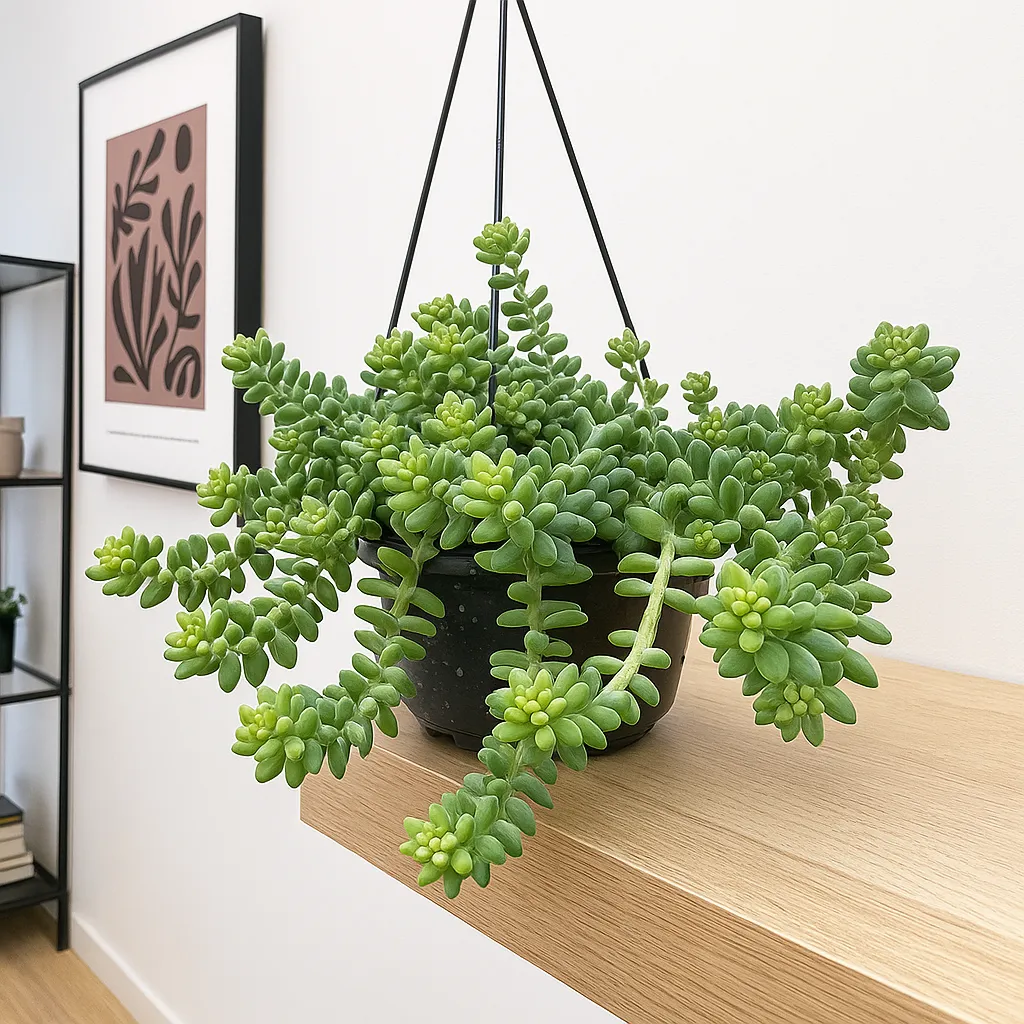
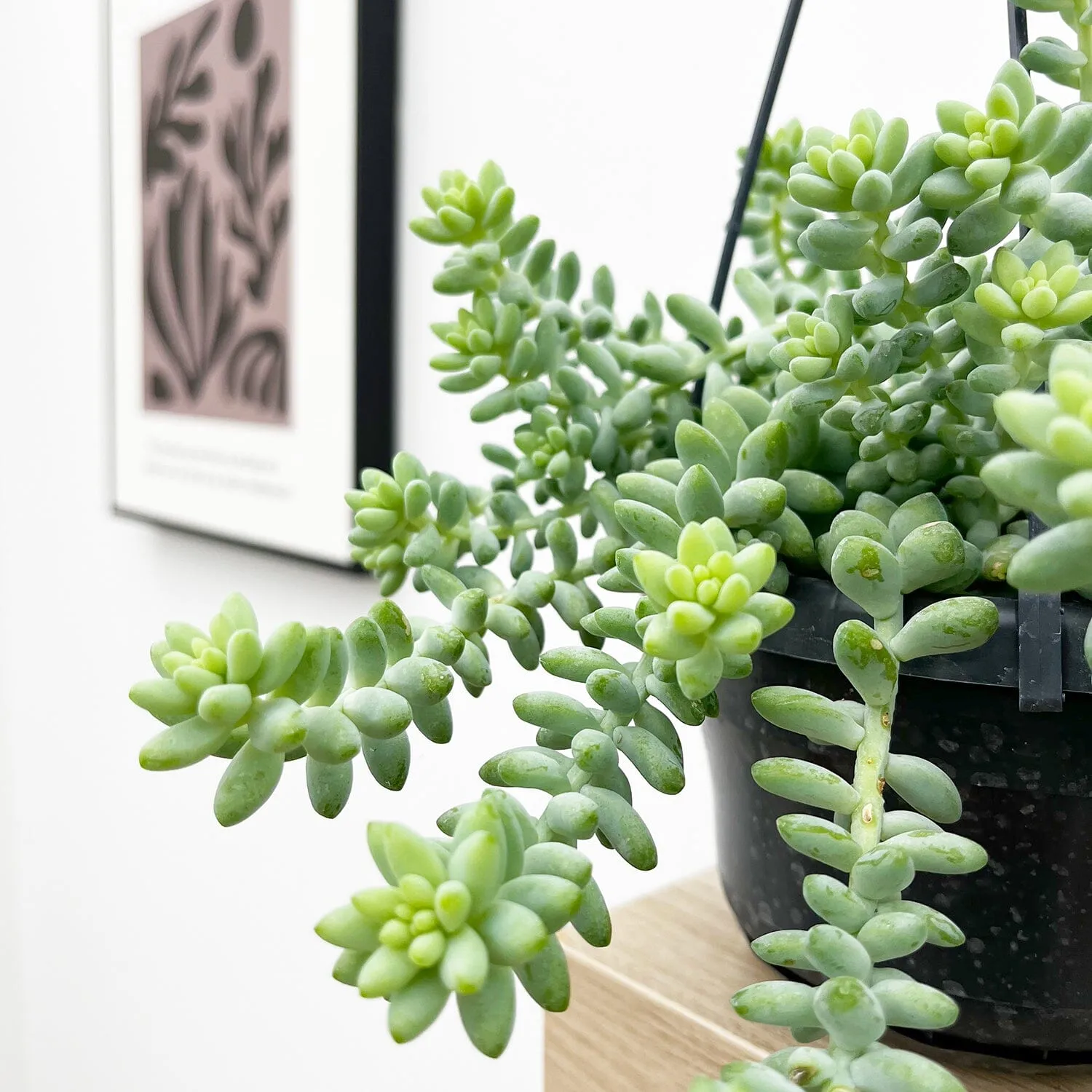
20 - 25cm Sedum Burrito Succulent in Hanging 14cm Pot
Sedum morganianum ‘Burrito’, commonly known as Burro’s Tail or Donkey’s Tail, is a beloved trailing succulent prized for its plump, cascading stems covered in overlapping, bead-like leaves. A member of the Crassulaceae family and native to the dry, rocky slopes of southern Mexico and Honduras, this variety is a true classic among collectors for its distinctive texture, trailing growth, and elegant, silvery-green hue.
Each trailing stem can reach up to 60 cm or more, densely packed with fleshy, teardrop-shaped leaves that form a soft, rope-like appearance. The foliage has a powdery coating of natural farina (epicuticular wax), giving it a silvery, matte finish and protecting the plant from sun and dehydration. In summer, mature plants may reward growers with clusters of small, pink to red, star-shaped flowers that emerge from the stem tips — a delicate contrast to its sculptural form.
Graceful, sculptural, and endlessly photogenic, Sedum ‘Burrito’ is a living cascade of texture and subtle colour — a perfect example of natural symmetry and desert elegance.
Sedum morganianum ‘Burrito’ – Care Guide
Light
Thrives in bright, indirect light to full sun. Provide at least 4–6 hours of bright light daily to encourage compact growth and maintain its silvery tone. Indoors, a south- or west-facing window is ideal. Too little light may cause leggy, stretched stems, while intense midday sun can scorch the delicate leaves.
Watering
Water sparingly. Allow the soil to dry out completely between waterings, then soak thoroughly and let excess water drain. Overwatering is the most common issue and can lead to leaf drop or rot. During winter dormancy, water only once every 3–4 weeks or when the leaves begin to wrinkle slightly.
Temperature and Humidity
-
Temperature: Prefers warm, dry conditions between 18–28 °C; avoid frost and temperatures below 10 °C.
-
Humidity: Thrives in low humidity; excess moisture in the air can cause fungal problems or rot. Ensure good airflow around the plant.
Soil and Potting
Use a gritty, fast-draining succulent mix, such as cactus soil combined with extra perlite or pumice. Terracotta pots are recommended to help excess moisture evaporate quickly. Repot only when necessary — the fragile leaves detach easily when handled.
Feeding
Feed lightly every 6–8 weeks in spring and summer with a diluted, low-nitrogen cactus fertiliser. Avoid fertilising in autumn and winter when the plant is dormant. Over-fertilising can result in soft, weak growth.
Pruning and Maintenance
Minimal pruning is required. Remove any dried or damaged stems to maintain a tidy appearance. Handle gently — Sedum ‘Burrito’ is known for its delicate leaves that detach easily at the slightest touch. These fallen leaves can be propagated to grow new plants.
Growth and Maturity
A slow to moderate grower, Sedum ‘Burrito’ typically reaches 30–60 cm in trailing length indoors, forming dense, draping cascades over time. Under ideal conditions, it can produce flowers in late spring or summer. Its sculptural quality and trailing habit make it one of the most iconic succulents for hanging planters or shelves.
Common Issues
-
Falling leaves: Handling or overwatering.
-
Shrivelling: Underwatering or prolonged drought.
-
Rot: Poor drainage or overly moist soil.
-
Pests: Occasionally mealybugs; treat with neem oil or insecticidal soap if needed.
Background and Benefits
Sedum morganianum ‘Burrito’ is closely related to Sedum morganianum, but differs slightly with shorter, rounder leaves that appear more tightly packed along the stem. Discovered in Mexico and Honduras, this species has adapted to arid, rocky conditions where it stores water in its succulent leaves to survive long dry periods.
Its trailing, geometric form has made it one of the most recognisable and photogenic succulents in the world — a favourite for both collectors and stylists. Like many Sedums, it also contributes to air purification, helping to create a cleaner, calmer indoor environment while requiring minimal care.
Quick Care Summary
Light: Bright, indirect to full sun; at least 4–6 hours daily
Water: Allow soil to dry completely between watering; water sparingly in winter
Temperature: 18–28 °C; avoid below 10 °C
Humidity: Low; prefers dry air and good ventilation
Soil: Gritty, free-draining mix – cactus soil, perlite, pumice
Feed: Every 6–8 weeks in spring/summer
Growth: Trailing succulent, 30–60 cm; plump, silvery-green bead-like leaves on cascading stems
⚠️ Toxicity note: Mildly toxic if ingested; keep away from pets and children.
Styling Tip
Display Sedum morganianum ‘Burrito’ in a hanging basket, shallow terracotta bowl, or elevated shelf, allowing its cascading stems to trail naturally. Its pale green tones pair beautifully with pink-tinged succulents such as Crassula marginalis rubra variegata (Calico Kitten) or upright species like Euphorbia trigona ‘Rubra’. For a minimalist aesthetic, style it in a simple white or concrete planter where its form and texture can shine. Perfect for sunny windowsills, balconies, or conservatories, it adds softness, movement, and timeless desert charm to any setting.
Original: $39.58
-70%$39.58
$11.87Product Information
Product Information
Shipping & Returns
Shipping & Returns
Description
Sedum morganianum ‘Burrito’, commonly known as Burro’s Tail or Donkey’s Tail, is a beloved trailing succulent prized for its plump, cascading stems covered in overlapping, bead-like leaves. A member of the Crassulaceae family and native to the dry, rocky slopes of southern Mexico and Honduras, this variety is a true classic among collectors for its distinctive texture, trailing growth, and elegant, silvery-green hue.
Each trailing stem can reach up to 60 cm or more, densely packed with fleshy, teardrop-shaped leaves that form a soft, rope-like appearance. The foliage has a powdery coating of natural farina (epicuticular wax), giving it a silvery, matte finish and protecting the plant from sun and dehydration. In summer, mature plants may reward growers with clusters of small, pink to red, star-shaped flowers that emerge from the stem tips — a delicate contrast to its sculptural form.
Graceful, sculptural, and endlessly photogenic, Sedum ‘Burrito’ is a living cascade of texture and subtle colour — a perfect example of natural symmetry and desert elegance.
Sedum morganianum ‘Burrito’ – Care Guide
Light
Thrives in bright, indirect light to full sun. Provide at least 4–6 hours of bright light daily to encourage compact growth and maintain its silvery tone. Indoors, a south- or west-facing window is ideal. Too little light may cause leggy, stretched stems, while intense midday sun can scorch the delicate leaves.
Watering
Water sparingly. Allow the soil to dry out completely between waterings, then soak thoroughly and let excess water drain. Overwatering is the most common issue and can lead to leaf drop or rot. During winter dormancy, water only once every 3–4 weeks or when the leaves begin to wrinkle slightly.
Temperature and Humidity
-
Temperature: Prefers warm, dry conditions between 18–28 °C; avoid frost and temperatures below 10 °C.
-
Humidity: Thrives in low humidity; excess moisture in the air can cause fungal problems or rot. Ensure good airflow around the plant.
Soil and Potting
Use a gritty, fast-draining succulent mix, such as cactus soil combined with extra perlite or pumice. Terracotta pots are recommended to help excess moisture evaporate quickly. Repot only when necessary — the fragile leaves detach easily when handled.
Feeding
Feed lightly every 6–8 weeks in spring and summer with a diluted, low-nitrogen cactus fertiliser. Avoid fertilising in autumn and winter when the plant is dormant. Over-fertilising can result in soft, weak growth.
Pruning and Maintenance
Minimal pruning is required. Remove any dried or damaged stems to maintain a tidy appearance. Handle gently — Sedum ‘Burrito’ is known for its delicate leaves that detach easily at the slightest touch. These fallen leaves can be propagated to grow new plants.
Growth and Maturity
A slow to moderate grower, Sedum ‘Burrito’ typically reaches 30–60 cm in trailing length indoors, forming dense, draping cascades over time. Under ideal conditions, it can produce flowers in late spring or summer. Its sculptural quality and trailing habit make it one of the most iconic succulents for hanging planters or shelves.
Common Issues
-
Falling leaves: Handling or overwatering.
-
Shrivelling: Underwatering or prolonged drought.
-
Rot: Poor drainage or overly moist soil.
-
Pests: Occasionally mealybugs; treat with neem oil or insecticidal soap if needed.
Background and Benefits
Sedum morganianum ‘Burrito’ is closely related to Sedum morganianum, but differs slightly with shorter, rounder leaves that appear more tightly packed along the stem. Discovered in Mexico and Honduras, this species has adapted to arid, rocky conditions where it stores water in its succulent leaves to survive long dry periods.
Its trailing, geometric form has made it one of the most recognisable and photogenic succulents in the world — a favourite for both collectors and stylists. Like many Sedums, it also contributes to air purification, helping to create a cleaner, calmer indoor environment while requiring minimal care.
Quick Care Summary
Light: Bright, indirect to full sun; at least 4–6 hours daily
Water: Allow soil to dry completely between watering; water sparingly in winter
Temperature: 18–28 °C; avoid below 10 °C
Humidity: Low; prefers dry air and good ventilation
Soil: Gritty, free-draining mix – cactus soil, perlite, pumice
Feed: Every 6–8 weeks in spring/summer
Growth: Trailing succulent, 30–60 cm; plump, silvery-green bead-like leaves on cascading stems
⚠️ Toxicity note: Mildly toxic if ingested; keep away from pets and children.
Styling Tip
Display Sedum morganianum ‘Burrito’ in a hanging basket, shallow terracotta bowl, or elevated shelf, allowing its cascading stems to trail naturally. Its pale green tones pair beautifully with pink-tinged succulents such as Crassula marginalis rubra variegata (Calico Kitten) or upright species like Euphorbia trigona ‘Rubra’. For a minimalist aesthetic, style it in a simple white or concrete planter where its form and texture can shine. Perfect for sunny windowsills, balconies, or conservatories, it adds softness, movement, and timeless desert charm to any setting.