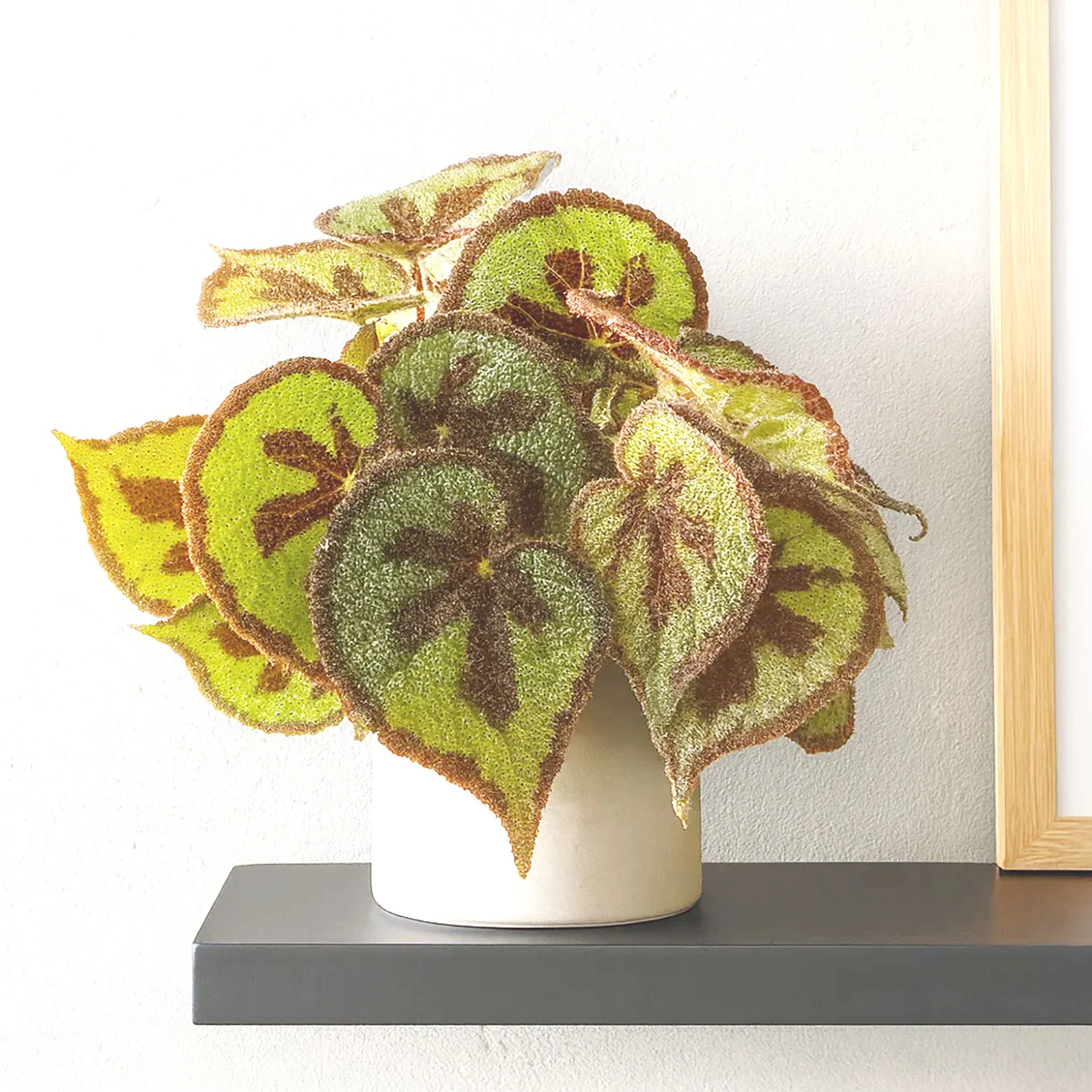
25 - 35cm Begonia Masoniana Mountain 14cm Pot House Plant
Begonia masoniana ‘Mountain’, a gorgeous form of the well-known Iron Cross Begonia, is a striking foliage plant admired for its dramatic leaf texture, rich colour, and rugged, mountain-valley surface pattern. A member of the Begoniaceae family and originally discovered in the tropical regions of China and Vietnam, this cultivar is celebrated for its bold, quilted leaves and the distinctive “mountainous” surface that sets it apart from standard Begonia masoniana.
Its large, rough, heavily blistered leaves are deep olive green with a raised, dark central cross or blotch. The rugged texture casts shadows across the leaf surface, giving it a three-dimensional, rock-face effect — hence the name ‘Mountain’. The petioles are covered in fine hairs, adding even more character and tactile charm. With its compact, bushy habit and standout foliage, this Begonia is a living artwork — perfect for collectors who love textured, dramatic plants.
Begonia masoniana ‘Mountain’ – Care Guide
Light
Thrives in bright, indirect light. It can tolerate medium light but avoid harsh direct sun, which can scorch its textured leaves. Best positioned near an east- or north-facing window or under grow lights.
Watering
Keep the soil evenly moist but never soggy. Water when the top 2–3 cm of soil feels slightly dry. Avoid getting water on the leaves, as the textured surface can trap moisture and cause spotting. Reduce watering slightly in winter while keeping humidity stable.
Temperature and Humidity
Temperature: Prefers 18–26 °C and must be protected from cold drafts and temperatures below 15 °C.
Humidity: High humidity (60–80%) is ideal. Use a humidifier, pebble tray, or greenhouse cabinet. Avoid misting directly onto the leaves.
Soil and Potting
Use a light, airy, moisture-retentive mix — compost with perlite, coco coir, and a little fine orchid bark works perfectly. This encourages drainage while keeping the roots evenly moist. Repot every 1–2 years in spring to refresh nutrients.
Feeding
Feed every 4–6 weeks in spring and summer with a diluted, balanced fertiliser. Avoid over-feeding, as Begonias are sensitive to salt build-up and can develop leaf burn.
Pruning and Maintenance
Remove any old or damaged leaves at the base to encourage fresh growth. Gently dust the textured leaves with a soft brush. Rotate occasionally to maintain even, symmetrical growth.
Growth and Maturity
Begonia masoniana ‘Mountain’ grows into a compact mound reaching 20–35 cm tall and wide. As it matures, the blistered leaf texture becomes more pronounced, making it increasingly dramatic and sculptural.
Common Issues
-
Crispy edges: Low humidity or underwatering.
-
Yellow leaves: Overwatering or poor drainage.
-
Leaf spotting: Water sitting on the textured surface.
-
Pests: Can attract fungus gnats or thrips — treat with neem oil or insecticidal soap.
Background and Benefits
Part of the famed Begonia masoniana group, the ‘Mountain’ form is prized for its rugged leaf surface, which resembles bumpy terrain or reptile skin. First popularised by collectors in Southeast Asia and Europe, this variety has become a favourite among terrarium enthusiasts and foliage lovers.
Symbolically, its strong structure and bold texture evoke resilience and grounding — making it a beautiful addition to calming interior spaces.
Quick Care Summary
-
Light: Bright, indirect light; avoid direct sun
-
Water: Lightly moist soil; avoid water on leaves
-
Temperature: 18–26 °C; avoid below 15 °C
-
Humidity: High (60–80%)
-
Soil: Airy mix – compost, perlite, coco coir, fine bark
-
Feed: Every 4–6 weeks in spring/summer
-
Growth: 20–35 cm; blistered, textured green leaves with dark cross pattern
⚠️ Toxicity note: Mildly toxic if ingested; keep away from pets and children.
Styling Tip
Display Begonia masoniana ‘Mountain’ where its textured foliage can be admired up close — on plant shelves, side tables, or inside a greenhouse cabinet. Pair it with smooth-leaved tropicals such as Philodendron ‘Birkin’, Ficus ‘Altissima’, or Homalomena ‘Cream Frost’ for contrast. Its rugged leaves look especially striking in matte, earthy ceramics or textured planters that emphasise its natural, dramatic form.
Original: $32.98
-70%$32.98
$9.89Product Information
Product Information
Shipping & Returns
Shipping & Returns
Description
Begonia masoniana ‘Mountain’, a gorgeous form of the well-known Iron Cross Begonia, is a striking foliage plant admired for its dramatic leaf texture, rich colour, and rugged, mountain-valley surface pattern. A member of the Begoniaceae family and originally discovered in the tropical regions of China and Vietnam, this cultivar is celebrated for its bold, quilted leaves and the distinctive “mountainous” surface that sets it apart from standard Begonia masoniana.
Its large, rough, heavily blistered leaves are deep olive green with a raised, dark central cross or blotch. The rugged texture casts shadows across the leaf surface, giving it a three-dimensional, rock-face effect — hence the name ‘Mountain’. The petioles are covered in fine hairs, adding even more character and tactile charm. With its compact, bushy habit and standout foliage, this Begonia is a living artwork — perfect for collectors who love textured, dramatic plants.
Begonia masoniana ‘Mountain’ – Care Guide
Light
Thrives in bright, indirect light. It can tolerate medium light but avoid harsh direct sun, which can scorch its textured leaves. Best positioned near an east- or north-facing window or under grow lights.
Watering
Keep the soil evenly moist but never soggy. Water when the top 2–3 cm of soil feels slightly dry. Avoid getting water on the leaves, as the textured surface can trap moisture and cause spotting. Reduce watering slightly in winter while keeping humidity stable.
Temperature and Humidity
Temperature: Prefers 18–26 °C and must be protected from cold drafts and temperatures below 15 °C.
Humidity: High humidity (60–80%) is ideal. Use a humidifier, pebble tray, or greenhouse cabinet. Avoid misting directly onto the leaves.
Soil and Potting
Use a light, airy, moisture-retentive mix — compost with perlite, coco coir, and a little fine orchid bark works perfectly. This encourages drainage while keeping the roots evenly moist. Repot every 1–2 years in spring to refresh nutrients.
Feeding
Feed every 4–6 weeks in spring and summer with a diluted, balanced fertiliser. Avoid over-feeding, as Begonias are sensitive to salt build-up and can develop leaf burn.
Pruning and Maintenance
Remove any old or damaged leaves at the base to encourage fresh growth. Gently dust the textured leaves with a soft brush. Rotate occasionally to maintain even, symmetrical growth.
Growth and Maturity
Begonia masoniana ‘Mountain’ grows into a compact mound reaching 20–35 cm tall and wide. As it matures, the blistered leaf texture becomes more pronounced, making it increasingly dramatic and sculptural.
Common Issues
-
Crispy edges: Low humidity or underwatering.
-
Yellow leaves: Overwatering or poor drainage.
-
Leaf spotting: Water sitting on the textured surface.
-
Pests: Can attract fungus gnats or thrips — treat with neem oil or insecticidal soap.
Background and Benefits
Part of the famed Begonia masoniana group, the ‘Mountain’ form is prized for its rugged leaf surface, which resembles bumpy terrain or reptile skin. First popularised by collectors in Southeast Asia and Europe, this variety has become a favourite among terrarium enthusiasts and foliage lovers.
Symbolically, its strong structure and bold texture evoke resilience and grounding — making it a beautiful addition to calming interior spaces.
Quick Care Summary
-
Light: Bright, indirect light; avoid direct sun
-
Water: Lightly moist soil; avoid water on leaves
-
Temperature: 18–26 °C; avoid below 15 °C
-
Humidity: High (60–80%)
-
Soil: Airy mix – compost, perlite, coco coir, fine bark
-
Feed: Every 4–6 weeks in spring/summer
-
Growth: 20–35 cm; blistered, textured green leaves with dark cross pattern
⚠️ Toxicity note: Mildly toxic if ingested; keep away from pets and children.
Styling Tip
Display Begonia masoniana ‘Mountain’ where its textured foliage can be admired up close — on plant shelves, side tables, or inside a greenhouse cabinet. Pair it with smooth-leaved tropicals such as Philodendron ‘Birkin’, Ficus ‘Altissima’, or Homalomena ‘Cream Frost’ for contrast. Its rugged leaves look especially striking in matte, earthy ceramics or textured planters that emphasise its natural, dramatic form.