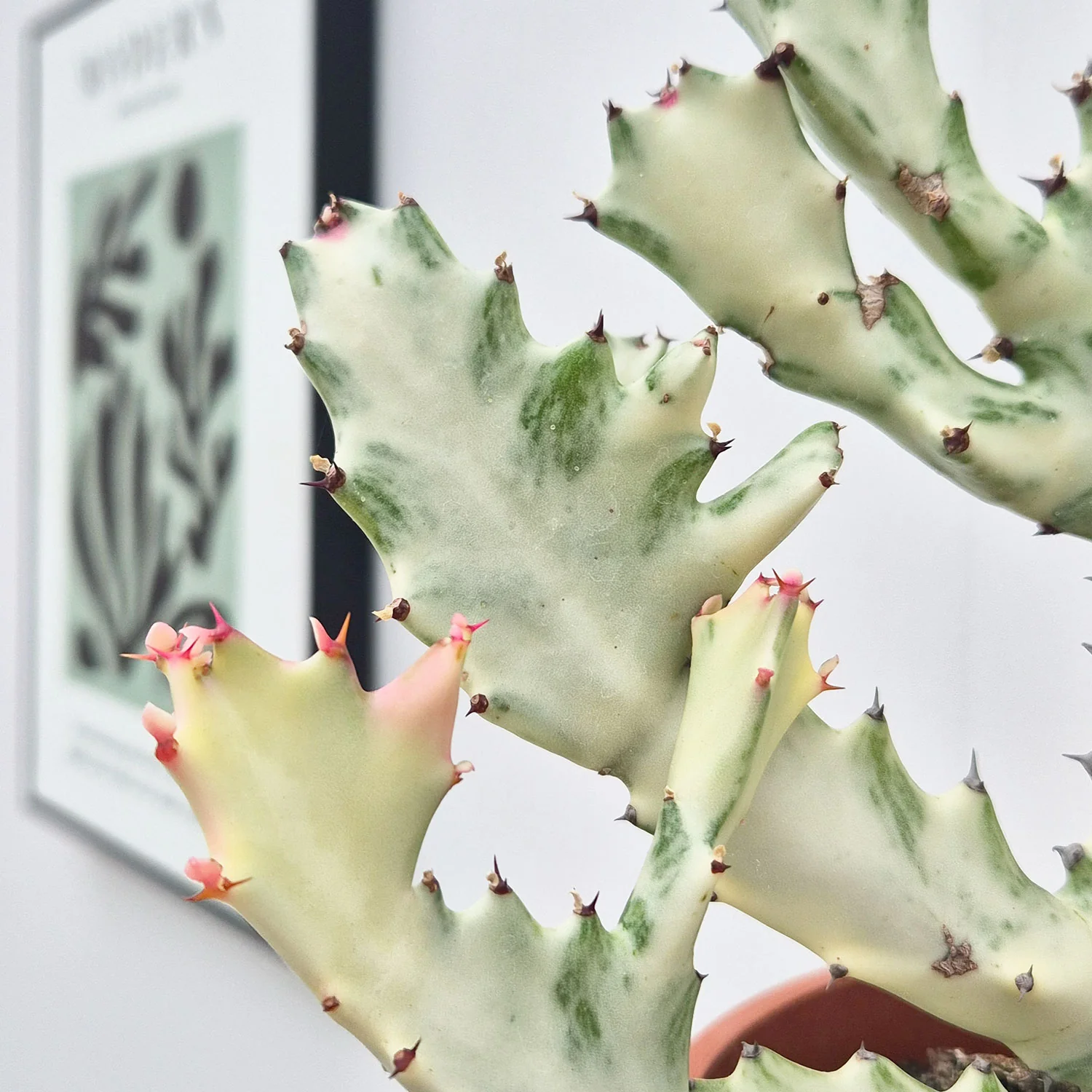


Euphorbia Lactea Ghost Cactus House Plant
Euphorbia lactea ‘White Ghost’, often called the Ghost Euphorbia or White Ghost Cactus, is an exceptionally rare and highly sought-after form of Euphorbia lactea, admired for its hauntingly beautiful, bone-white colouring and sculptural shape. A member of the Euphorbiaceae family and native to tropical Asia, this variety is a collector’s dream — elegant, minimalist, and truly otherworldly.
Unlike typical green Euphorbia lactea, the ‘White Ghost’ cultivar is characterised by its pale ivory to silvery-white stems, often marbled with faint hints of soft green, blush pink, or creamy grey. The upright, branching stems form a dramatic candelabra-like structure, with ridged edges lined by tiny thorns. Its stark, ghostly hue and striking architecture make it a living piece of modern art — ideal for contemporary interiors or as a show-stopping feature in bright, arid plant displays.
Mysterious, architectural, and almost ethereal in its appearance, Euphorbia lactea ‘White Ghost’ brings rare desert elegance to any plant collection.
Euphorbia lactea ‘White Ghost’ – Care Guide
Light
Thrives in bright, indirect to full sunlight. Provide at least 4–6 hours of bright light daily to maintain its creamy-white colouration and pink blush tones. Too little light can cause the stems to revert to green, while excessive direct sun may cause scorching.
Watering
Water sparingly. Allow the soil to dry out completely between waterings, then water thoroughly and let excess drain away. In winter, reduce watering to once every 4–6 weeks. Overwatering is the most common cause of root and stem rot — err on the side of dryness.
Temperature and Humidity
Temperature: Prefers warmth between 18–30 °C; avoid exposure to cold below 12 °C. Protect from frost and drafts.
Humidity: Low to average humidity is ideal. Euphorbia lactea ‘White Ghost’ thrives in dry air and requires no misting.
Soil and Potting
Use a well-draining cactus or succulent mix — a blend of compost, coarse sand, and perlite or pumice works best. This allows the soil to dry quickly and prevents root rot. Repot every 2–3 years in spring, refreshing the soil and choosing a pot with good drainage.
Feeding
Feed lightly every 6–8 weeks during spring and summer with a diluted cactus or succulent fertiliser. Avoid fertilising during autumn and winter when growth slows.
Pruning and Maintenance
Minimal maintenance is required. Remove any damaged or discoloured stems with sterilised tools. Always wear gloves when handling, as the milky white latex sap is toxic and irritating to the skin and eyes. Dust occasionally with a soft cloth to keep its pale surface pristine.
Growth and Maturity
A slow-growing succulent, Euphorbia lactea ‘White Ghost’ typically reaches 60–120 cm in height indoors, with upright, branching stems that can form a candelabra shape over time. In ideal conditions, it may produce tiny yellow-green flowers at the tips of the stems, though these are rare and short-lived.
Common Issues
-
Soft or collapsing stems: Overwatering or poor drainage.
-
Fading colour (turning green): Insufficient light.
-
Sunburn (brown patches): Too much direct, intense sunlight.
-
Pests: Occasionally affected by mealybugs or scale — remove gently with neem oil or insecticidal soap.
Background and Benefits
Native to tropical India, Sri Lanka, and Southeast Asia, Euphorbia lactea naturally thrives in dry, rocky environments where it endures long periods of drought and intense sunlight. The ‘White Ghost’ form is a variegated mutation cultivated for its ethereal, pale colouring and extraordinary ornamental value. It is often used in interior design for its clean, sculptural lines and subtle colour palette.
Symbolically, the Ghost Euphorbia represents endurance, transformation, and purity — qualities reflected in its ability to thrive under extreme conditions while maintaining its delicate, luminous appearance.
Quick Care Summary
-
Light: Bright, indirect to full sunlight; 4–6 hours daily
-
Water: Let soil dry out completely before watering
-
Temperature: 18–30 °C; avoid below 12 °C
-
Humidity: Low to average; thrives in dry air
-
Soil: Free-draining cactus/succulent mix – compost, sand, perlite
-
Feed: Every 6–8 weeks in spring/summer
-
Growth: 60–120 cm tall; upright, branching, bone-white stems with faint green and pink marbling
⚠️ Toxicity note: Highly toxic if ingested; the milky sap can cause severe skin and eye irritation. Always handle with gloves and keep out of reach of pets and children.
Styling Tip
Showcase Euphorbia lactea ‘White Ghost’ as a statement plant in a minimalist or modern setting, where its pale tones and sculptural form can truly shine. Pair it with dark, textured planters for dramatic contrast or with neutral ceramics for a clean, contemporary look. It makes a striking companion to other arid plants such as Sansevieria ‘Moonshine’, Aloe vera, or Euphorbia trigona ‘Rubra’. Perfect for bright living rooms, conservatories, or offices, this rare Euphorbia brings a sense of calm, balance, and natural artistry to any space.
Original: $85.77
-70%$85.77
$25.73Product Information
Product Information
Shipping & Returns
Shipping & Returns
Description
Euphorbia lactea ‘White Ghost’, often called the Ghost Euphorbia or White Ghost Cactus, is an exceptionally rare and highly sought-after form of Euphorbia lactea, admired for its hauntingly beautiful, bone-white colouring and sculptural shape. A member of the Euphorbiaceae family and native to tropical Asia, this variety is a collector’s dream — elegant, minimalist, and truly otherworldly.
Unlike typical green Euphorbia lactea, the ‘White Ghost’ cultivar is characterised by its pale ivory to silvery-white stems, often marbled with faint hints of soft green, blush pink, or creamy grey. The upright, branching stems form a dramatic candelabra-like structure, with ridged edges lined by tiny thorns. Its stark, ghostly hue and striking architecture make it a living piece of modern art — ideal for contemporary interiors or as a show-stopping feature in bright, arid plant displays.
Mysterious, architectural, and almost ethereal in its appearance, Euphorbia lactea ‘White Ghost’ brings rare desert elegance to any plant collection.
Euphorbia lactea ‘White Ghost’ – Care Guide
Light
Thrives in bright, indirect to full sunlight. Provide at least 4–6 hours of bright light daily to maintain its creamy-white colouration and pink blush tones. Too little light can cause the stems to revert to green, while excessive direct sun may cause scorching.
Watering
Water sparingly. Allow the soil to dry out completely between waterings, then water thoroughly and let excess drain away. In winter, reduce watering to once every 4–6 weeks. Overwatering is the most common cause of root and stem rot — err on the side of dryness.
Temperature and Humidity
Temperature: Prefers warmth between 18–30 °C; avoid exposure to cold below 12 °C. Protect from frost and drafts.
Humidity: Low to average humidity is ideal. Euphorbia lactea ‘White Ghost’ thrives in dry air and requires no misting.
Soil and Potting
Use a well-draining cactus or succulent mix — a blend of compost, coarse sand, and perlite or pumice works best. This allows the soil to dry quickly and prevents root rot. Repot every 2–3 years in spring, refreshing the soil and choosing a pot with good drainage.
Feeding
Feed lightly every 6–8 weeks during spring and summer with a diluted cactus or succulent fertiliser. Avoid fertilising during autumn and winter when growth slows.
Pruning and Maintenance
Minimal maintenance is required. Remove any damaged or discoloured stems with sterilised tools. Always wear gloves when handling, as the milky white latex sap is toxic and irritating to the skin and eyes. Dust occasionally with a soft cloth to keep its pale surface pristine.
Growth and Maturity
A slow-growing succulent, Euphorbia lactea ‘White Ghost’ typically reaches 60–120 cm in height indoors, with upright, branching stems that can form a candelabra shape over time. In ideal conditions, it may produce tiny yellow-green flowers at the tips of the stems, though these are rare and short-lived.
Common Issues
-
Soft or collapsing stems: Overwatering or poor drainage.
-
Fading colour (turning green): Insufficient light.
-
Sunburn (brown patches): Too much direct, intense sunlight.
-
Pests: Occasionally affected by mealybugs or scale — remove gently with neem oil or insecticidal soap.
Background and Benefits
Native to tropical India, Sri Lanka, and Southeast Asia, Euphorbia lactea naturally thrives in dry, rocky environments where it endures long periods of drought and intense sunlight. The ‘White Ghost’ form is a variegated mutation cultivated for its ethereal, pale colouring and extraordinary ornamental value. It is often used in interior design for its clean, sculptural lines and subtle colour palette.
Symbolically, the Ghost Euphorbia represents endurance, transformation, and purity — qualities reflected in its ability to thrive under extreme conditions while maintaining its delicate, luminous appearance.
Quick Care Summary
-
Light: Bright, indirect to full sunlight; 4–6 hours daily
-
Water: Let soil dry out completely before watering
-
Temperature: 18–30 °C; avoid below 12 °C
-
Humidity: Low to average; thrives in dry air
-
Soil: Free-draining cactus/succulent mix – compost, sand, perlite
-
Feed: Every 6–8 weeks in spring/summer
-
Growth: 60–120 cm tall; upright, branching, bone-white stems with faint green and pink marbling
⚠️ Toxicity note: Highly toxic if ingested; the milky sap can cause severe skin and eye irritation. Always handle with gloves and keep out of reach of pets and children.
Styling Tip
Showcase Euphorbia lactea ‘White Ghost’ as a statement plant in a minimalist or modern setting, where its pale tones and sculptural form can truly shine. Pair it with dark, textured planters for dramatic contrast or with neutral ceramics for a clean, contemporary look. It makes a striking companion to other arid plants such as Sansevieria ‘Moonshine’, Aloe vera, or Euphorbia trigona ‘Rubra’. Perfect for bright living rooms, conservatories, or offices, this rare Euphorbia brings a sense of calm, balance, and natural artistry to any space.