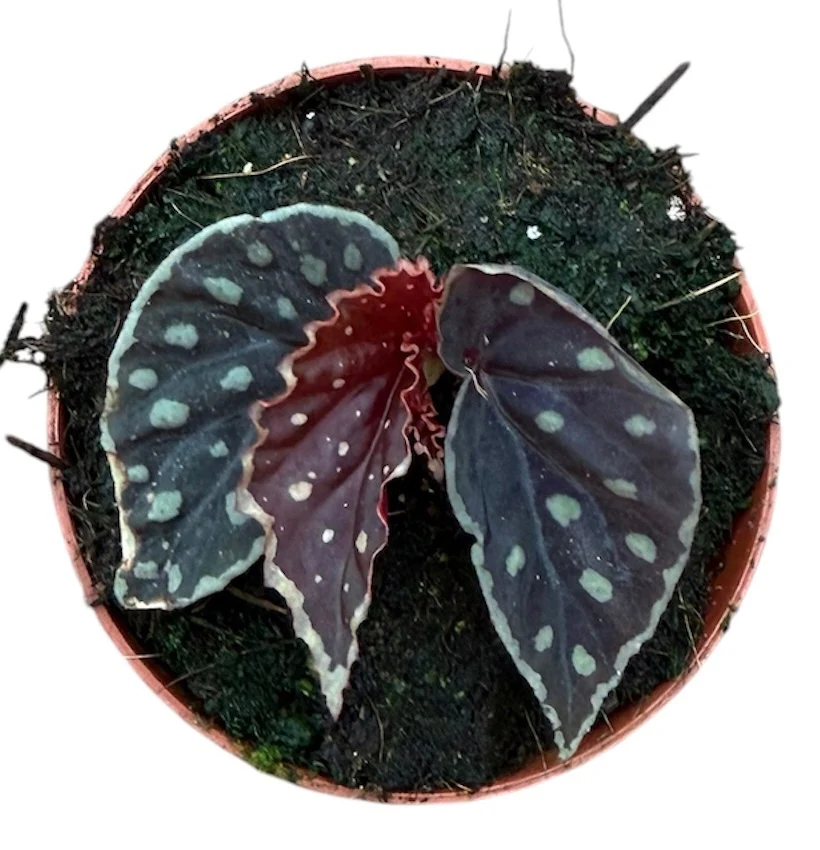

Begonia Fire Fly 8cm Pot 15cm Height House Plant
Begonia Fire Fly is a vivid rex begonia with glowing foliage in shades of bright red, hot pink and deep burgundy. The large, slightly spiralled leaves have a fiery red centre that fades into darker burgundy or almost black edges, often with a fine metallic sheen across the surface. In bright indirect light, the foliage appears to glow, giving the plant its ‘Fire Fly’ name.
The leaves are broad and softly textured with lightly ruffled edges and deep veining. The undersides are usually rich burgundy-red, adding even more colour and contrast. Mature plants form a compact, bushy mound around 20–30cm tall and wide.
Although Begonia Fire Fly may occasionally produce small pale pink flowers, it is grown mainly for its dramatic foliage. Its intense red colouring makes it an ideal addition to your Pink Hues collection, pairing beautifully with Aglaonema ‘Pink Star’, Ficus ‘Belize’ and Syngonium ‘Pink Robusta’. It also works well within your Dark Collection thanks to the darker edges of the leaves.
Detailed Care Guide
Light
Begonia Fire Fly prefers bright, indirect light.
A position near an east or north-facing window is ideal. It can tolerate a little gentle morning sun, but avoid strong direct sunlight, particularly in the afternoon, as this can scorch the leaves and fade the fiery colours.
Too little light may cause the plant to lose some of its vibrant red tones.
Watering
Allow the top 2–3cm of compost to dry slightly between waterings.
- Keep the compost lightly moist but not wet
- Water thoroughly, then allow excess water to drain away
- Never let the plant sit in water
- Reduce watering during winter
Overwatering can quickly cause root rot and soft stems, so it is better to let the top of the compost dry slightly before watering again.
Always water at the base of the plant and avoid wetting the leaves.
Humidity
Begonia Fire Fly enjoys moderate to high humidity, ideally around 50–70%.
To increase humidity:
- Group it with other houseplants
- Use a pebble tray
- Place a humidifier nearby
Avoid misting directly onto the foliage, as rex begonias can develop marks or mildew if water remains on the leaves.
Temperature
Keep Begonia Fire Fly in temperatures between 18–24°C.
Protect it from:
- Temperatures below 15°C
- Cold draughts
- Sudden changes in temperature
- Radiators and heaters
Compost
Use a light, free-draining compost mix that still holds some moisture.
A good mix is:
- 2 parts houseplant compost
- 1 part perlite
- 1 part orchid bark or coco chips
This keeps the roots healthy whilst preventing soggy compost.
Feeding
Feed every 2–4 weeks during spring and summer with a balanced liquid houseplant fertiliser diluted to half strength.
Avoid feeding in autumn and winter when the plant is growing more slowly.
Repotting
Repot every 1–2 years in spring if needed.
Only move it into a pot one size larger if:
- Roots are growing from the drainage holes
- The compost dries out very quickly
- The plant has become overcrowded
Begonia Fire Fly usually prefers to stay slightly snug in its pot.
Common Problems
- Brown crispy edges: Low humidity or dry compost
- Yellow leaves: Usually caused by overwatering
- Brown patches: Too much direct sun or water left on the leaves
- Duller, greener foliage: Not enough light
- Soft stems or collapsing growth: Root rot caused by wet compost
Pet Safety
Begonia Fire Fly is toxic if eaten and should be kept away from pets and young children. The leaves and stems can cause irritation and stomach upset if consumed.
Original: $46.18
-70%$46.18
$13.85Product Information
Product Information
Shipping & Returns
Shipping & Returns
Description
Begonia Fire Fly is a vivid rex begonia with glowing foliage in shades of bright red, hot pink and deep burgundy. The large, slightly spiralled leaves have a fiery red centre that fades into darker burgundy or almost black edges, often with a fine metallic sheen across the surface. In bright indirect light, the foliage appears to glow, giving the plant its ‘Fire Fly’ name.
The leaves are broad and softly textured with lightly ruffled edges and deep veining. The undersides are usually rich burgundy-red, adding even more colour and contrast. Mature plants form a compact, bushy mound around 20–30cm tall and wide.
Although Begonia Fire Fly may occasionally produce small pale pink flowers, it is grown mainly for its dramatic foliage. Its intense red colouring makes it an ideal addition to your Pink Hues collection, pairing beautifully with Aglaonema ‘Pink Star’, Ficus ‘Belize’ and Syngonium ‘Pink Robusta’. It also works well within your Dark Collection thanks to the darker edges of the leaves.
Detailed Care Guide
Light
Begonia Fire Fly prefers bright, indirect light.
A position near an east or north-facing window is ideal. It can tolerate a little gentle morning sun, but avoid strong direct sunlight, particularly in the afternoon, as this can scorch the leaves and fade the fiery colours.
Too little light may cause the plant to lose some of its vibrant red tones.
Watering
Allow the top 2–3cm of compost to dry slightly between waterings.
- Keep the compost lightly moist but not wet
- Water thoroughly, then allow excess water to drain away
- Never let the plant sit in water
- Reduce watering during winter
Overwatering can quickly cause root rot and soft stems, so it is better to let the top of the compost dry slightly before watering again.
Always water at the base of the plant and avoid wetting the leaves.
Humidity
Begonia Fire Fly enjoys moderate to high humidity, ideally around 50–70%.
To increase humidity:
- Group it with other houseplants
- Use a pebble tray
- Place a humidifier nearby
Avoid misting directly onto the foliage, as rex begonias can develop marks or mildew if water remains on the leaves.
Temperature
Keep Begonia Fire Fly in temperatures between 18–24°C.
Protect it from:
- Temperatures below 15°C
- Cold draughts
- Sudden changes in temperature
- Radiators and heaters
Compost
Use a light, free-draining compost mix that still holds some moisture.
A good mix is:
- 2 parts houseplant compost
- 1 part perlite
- 1 part orchid bark or coco chips
This keeps the roots healthy whilst preventing soggy compost.
Feeding
Feed every 2–4 weeks during spring and summer with a balanced liquid houseplant fertiliser diluted to half strength.
Avoid feeding in autumn and winter when the plant is growing more slowly.
Repotting
Repot every 1–2 years in spring if needed.
Only move it into a pot one size larger if:
- Roots are growing from the drainage holes
- The compost dries out very quickly
- The plant has become overcrowded
Begonia Fire Fly usually prefers to stay slightly snug in its pot.
Common Problems
- Brown crispy edges: Low humidity or dry compost
- Yellow leaves: Usually caused by overwatering
- Brown patches: Too much direct sun or water left on the leaves
- Duller, greener foliage: Not enough light
- Soft stems or collapsing growth: Root rot caused by wet compost
Pet Safety
Begonia Fire Fly is toxic if eaten and should be kept away from pets and young children. The leaves and stems can cause irritation and stomach upset if consumed.