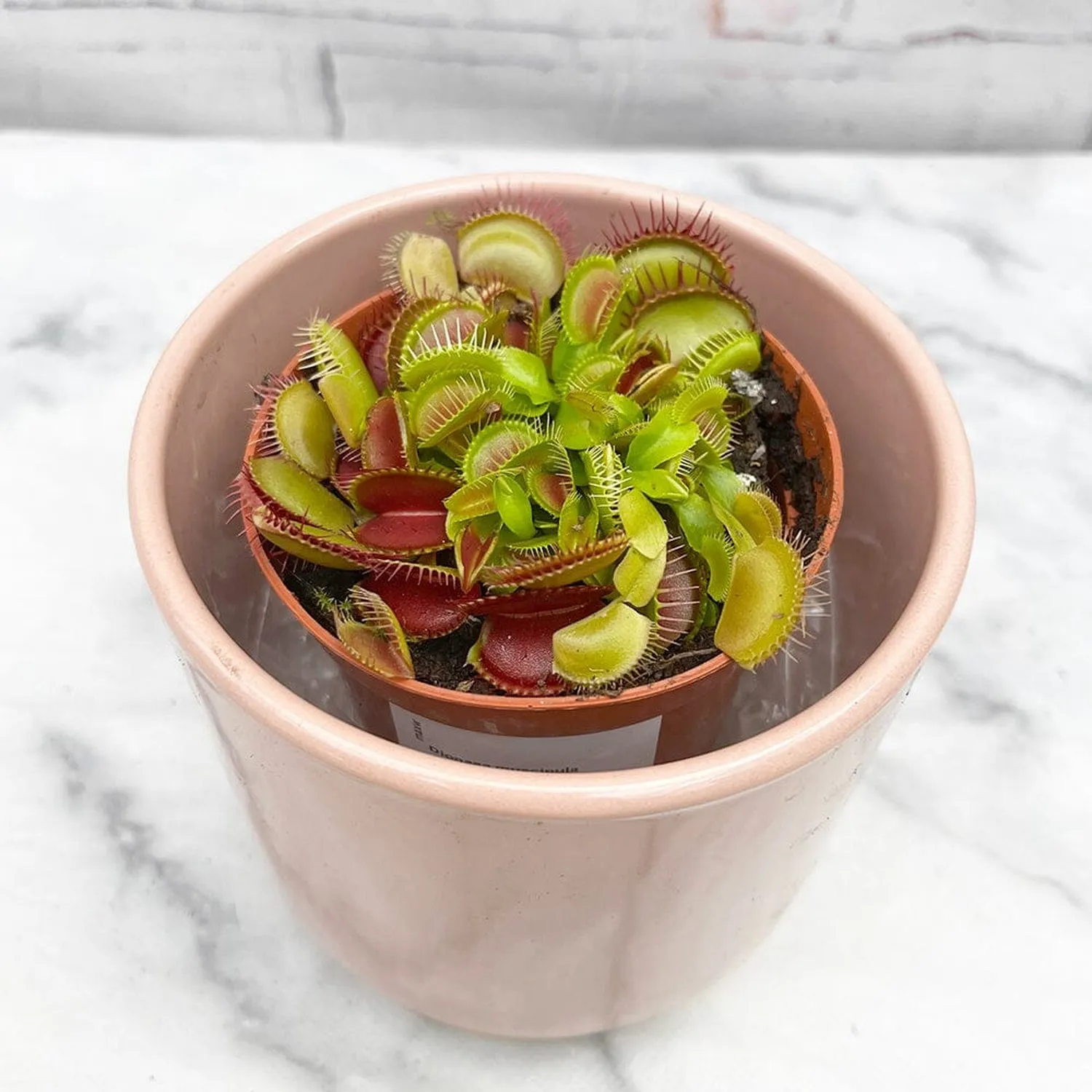
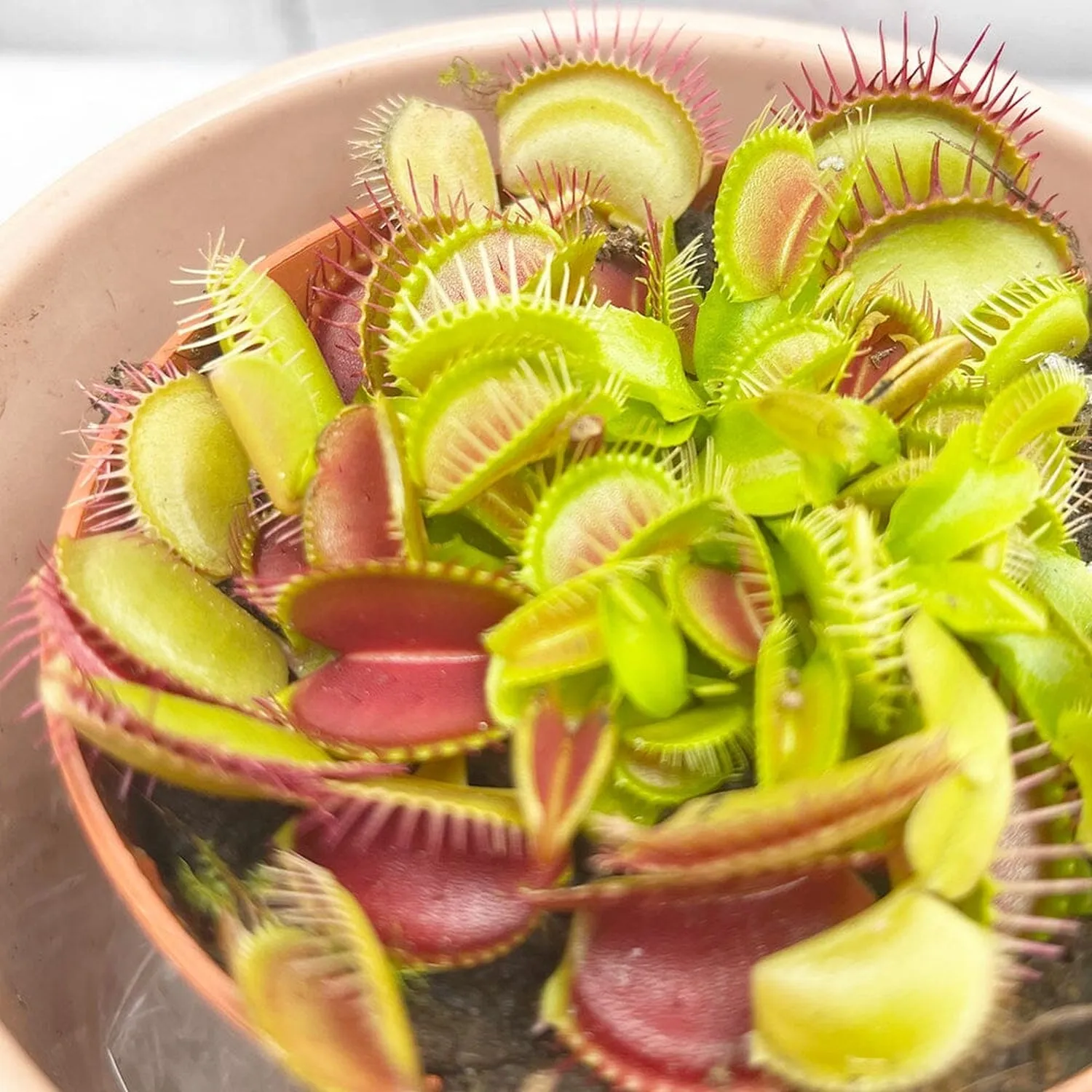
10 - 15cm Venus Fly Trap Dionaea Muscipula 9cm Pot
The Venus Flytrap (Dionaea muscipula) is one of the world's most fascinating carnivorous plants, famous for its unique trapping mechanism that allows it to capture and digest insects. Native to the nutrient-poor bogs and wetlands of North and South Carolina in the United States, this remarkable plant has evolved specialised leaves that snap shut when triggered by unsuspecting prey.
Each trap consists of two hinged lobes lined with sensitive trigger hairs. When an insect touches these hairs multiple times within a short period, the trap rapidly closes, preventing escape. The plant then secretes digestive enzymes to break down its prey and absorb valuable nutrients.
Despite its exotic appearance, the Venus Flytrap can be successfully grown as a houseplant or patio plant when its specific growing requirements are met. Unlike most houseplants, it requires very pure water, nutrient-poor soil and a winter dormancy period to remain healthy long-term.
Plant Characteristics
- Botanical Name: Dionaea muscipula
- Common Name: Venus Flytrap
- Plant Type: Carnivorous perennial
- Growth Habit: Compact rosette
- Mature Height: 10–15cm
- Mature Spread: 10–20cm
- Growth Rate: Moderate
- Difficulty Level: Moderate
- Pet Friendly: Generally non-toxic
Venus Flytrap Care Guide
Light Requirements
Venus Flytraps require far more light than most indoor plants.
For best growth, provide:
- At least 6 hours of direct sunlight daily
- A bright south-facing windowsill
- A greenhouse or conservatory position
- Outdoor growing during spring and summer where possible
Insufficient light can result in:
- Weak growth
- Small traps
- Poor colouring
- Reduced vigour
Plants grown outdoors often develop red colouring inside their traps when receiving sufficient sunlight.
Watering
Water quality is critical.
Venus Flytraps should only be watered with:
- Rainwater
- Distilled water
- Reverse osmosis water
Never use tap water unless it is exceptionally low in dissolved minerals, as mineral build-up can damage or kill the plant.
Keep the compost consistently moist during the growing season.
A common method is the tray technique:
- Place the pot in a shallow tray.
- Maintain 1–2cm of water in the tray.
- Allow occasional drying of the tray before refilling.
Do not allow the compost to dry out completely.
Humidity
Venus Flytraps tolerate a wide range of humidity levels.
Typical UK household humidity is usually sufficient provided the plant receives adequate water and airflow.
Avoid sealed terrariums, which often encourage mould and poor air circulation.
Temperature
During active growth:
- 18°C–30°C
During winter dormancy:
- 0°C–10°C
The plant naturally experiences cold winters in its native habitat and requires a dormant period every year.
Soil Requirements
Venus Flytraps require nutrient-poor soil.
Suitable growing media include:
- 50% sphagnum peat moss
- 50% perlite
Alternatively:
- Carnivorous plant compost
Never use:
- Standard houseplant compost
- Fertilised compost
- Garden soil
Nutrient-rich soils can damage the roots.
Feeding
Venus Flytraps obtain nutrients from insects rather than fertilisers.
If grown outdoors, they will usually catch enough insects naturally.
If grown indoors:
- Occasional small insects can be offered
- Avoid feeding large insects
- Do not feed meat, cheese or human food
Each trap can only close a limited number of times before naturally dying back.
Avoid triggering traps unnecessarily.
Winter Dormancy
Dormancy is essential for long-term health.
From late autumn to early spring:
- Growth slows significantly
- Traps may blacken and die back
- Water requirements decrease
- The plant should be kept cool
Without dormancy, Venus Flytraps often weaken and eventually decline.
Repotting
Repot every:
- 1–2 years
- Preferably in late winter or early spring
Replace the growing medium completely to maintain good root health.
Flowering
Mature plants produce:
- Tall flower stalks
- Small white flowers
- Blooms during spring
Many growers remove flower stalks early to conserve energy and encourage larger traps.
Common Problems
Black Traps
Usually normal ageing.
Individual traps naturally die after:
- Several successful captures
- Repeated triggering
- Natural ageing
Remove dead traps once fully black.
Weak Growth
Usually caused by:
- Insufficient light
- Lack of dormancy
- Poor water quality
Traps Not Closing
May indicate:
- Dormancy
- Weak growth
- Old traps nearing the end of their lifespan
Mineral Damage
Symptoms include:
- Browning leaves
- Poor growth
- Sudden decline
Most often caused by tap water or fertilised compost.
Propagation
Venus Flytraps can be propagated through:
- Division of mature plants
- Leaf pullings
- Seed (more advanced)
Mature plants often form multiple growing points that can be separated during repotting.
Toxicity
Venus Flytraps are generally considered non-toxic to cats, dogs and humans. While not harmful, they should not be consumed.
Quick Care Summary
| Care Aspect | Requirement |
|---|---|
| Light | 6+ hours direct sunlight |
| Water | Rainwater or distilled water only |
| Humidity | Average to high |
| Temperature | 18–30°C growing season |
| Soil | Nutrient-poor carnivorous plant mix |
| Feeding | Insects only |
| Growth Rate | Moderate |
| Difficulty | Moderate |
| Pet Safe | Generally yes |
The Venus Flytrap is one of the most extraordinary plants you can grow at home. By providing bright sunlight, pure water, nutrient-poor soil and a proper winter dormancy period, this fascinating carnivorous plant can thrive for many years while providing a unique and captivating display. 🪰🌱
Original: $11.86
-70%$11.86
$3.56Product Information
Product Information
Shipping & Returns
Shipping & Returns
Description
The Venus Flytrap (Dionaea muscipula) is one of the world's most fascinating carnivorous plants, famous for its unique trapping mechanism that allows it to capture and digest insects. Native to the nutrient-poor bogs and wetlands of North and South Carolina in the United States, this remarkable plant has evolved specialised leaves that snap shut when triggered by unsuspecting prey.
Each trap consists of two hinged lobes lined with sensitive trigger hairs. When an insect touches these hairs multiple times within a short period, the trap rapidly closes, preventing escape. The plant then secretes digestive enzymes to break down its prey and absorb valuable nutrients.
Despite its exotic appearance, the Venus Flytrap can be successfully grown as a houseplant or patio plant when its specific growing requirements are met. Unlike most houseplants, it requires very pure water, nutrient-poor soil and a winter dormancy period to remain healthy long-term.
Plant Characteristics
- Botanical Name: Dionaea muscipula
- Common Name: Venus Flytrap
- Plant Type: Carnivorous perennial
- Growth Habit: Compact rosette
- Mature Height: 10–15cm
- Mature Spread: 10–20cm
- Growth Rate: Moderate
- Difficulty Level: Moderate
- Pet Friendly: Generally non-toxic
Venus Flytrap Care Guide
Light Requirements
Venus Flytraps require far more light than most indoor plants.
For best growth, provide:
- At least 6 hours of direct sunlight daily
- A bright south-facing windowsill
- A greenhouse or conservatory position
- Outdoor growing during spring and summer where possible
Insufficient light can result in:
- Weak growth
- Small traps
- Poor colouring
- Reduced vigour
Plants grown outdoors often develop red colouring inside their traps when receiving sufficient sunlight.
Watering
Water quality is critical.
Venus Flytraps should only be watered with:
- Rainwater
- Distilled water
- Reverse osmosis water
Never use tap water unless it is exceptionally low in dissolved minerals, as mineral build-up can damage or kill the plant.
Keep the compost consistently moist during the growing season.
A common method is the tray technique:
- Place the pot in a shallow tray.
- Maintain 1–2cm of water in the tray.
- Allow occasional drying of the tray before refilling.
Do not allow the compost to dry out completely.
Humidity
Venus Flytraps tolerate a wide range of humidity levels.
Typical UK household humidity is usually sufficient provided the plant receives adequate water and airflow.
Avoid sealed terrariums, which often encourage mould and poor air circulation.
Temperature
During active growth:
- 18°C–30°C
During winter dormancy:
- 0°C–10°C
The plant naturally experiences cold winters in its native habitat and requires a dormant period every year.
Soil Requirements
Venus Flytraps require nutrient-poor soil.
Suitable growing media include:
- 50% sphagnum peat moss
- 50% perlite
Alternatively:
- Carnivorous plant compost
Never use:
- Standard houseplant compost
- Fertilised compost
- Garden soil
Nutrient-rich soils can damage the roots.
Feeding
Venus Flytraps obtain nutrients from insects rather than fertilisers.
If grown outdoors, they will usually catch enough insects naturally.
If grown indoors:
- Occasional small insects can be offered
- Avoid feeding large insects
- Do not feed meat, cheese or human food
Each trap can only close a limited number of times before naturally dying back.
Avoid triggering traps unnecessarily.
Winter Dormancy
Dormancy is essential for long-term health.
From late autumn to early spring:
- Growth slows significantly
- Traps may blacken and die back
- Water requirements decrease
- The plant should be kept cool
Without dormancy, Venus Flytraps often weaken and eventually decline.
Repotting
Repot every:
- 1–2 years
- Preferably in late winter or early spring
Replace the growing medium completely to maintain good root health.
Flowering
Mature plants produce:
- Tall flower stalks
- Small white flowers
- Blooms during spring
Many growers remove flower stalks early to conserve energy and encourage larger traps.
Common Problems
Black Traps
Usually normal ageing.
Individual traps naturally die after:
- Several successful captures
- Repeated triggering
- Natural ageing
Remove dead traps once fully black.
Weak Growth
Usually caused by:
- Insufficient light
- Lack of dormancy
- Poor water quality
Traps Not Closing
May indicate:
- Dormancy
- Weak growth
- Old traps nearing the end of their lifespan
Mineral Damage
Symptoms include:
- Browning leaves
- Poor growth
- Sudden decline
Most often caused by tap water or fertilised compost.
Propagation
Venus Flytraps can be propagated through:
- Division of mature plants
- Leaf pullings
- Seed (more advanced)
Mature plants often form multiple growing points that can be separated during repotting.
Toxicity
Venus Flytraps are generally considered non-toxic to cats, dogs and humans. While not harmful, they should not be consumed.
Quick Care Summary
| Care Aspect | Requirement |
|---|---|
| Light | 6+ hours direct sunlight |
| Water | Rainwater or distilled water only |
| Humidity | Average to high |
| Temperature | 18–30°C growing season |
| Soil | Nutrient-poor carnivorous plant mix |
| Feeding | Insects only |
| Growth Rate | Moderate |
| Difficulty | Moderate |
| Pet Safe | Generally yes |
The Venus Flytrap is one of the most extraordinary plants you can grow at home. By providing bright sunlight, pure water, nutrient-poor soil and a proper winter dormancy period, this fascinating carnivorous plant can thrive for many years while providing a unique and captivating display. 🪰🌱